
Product Knowledge
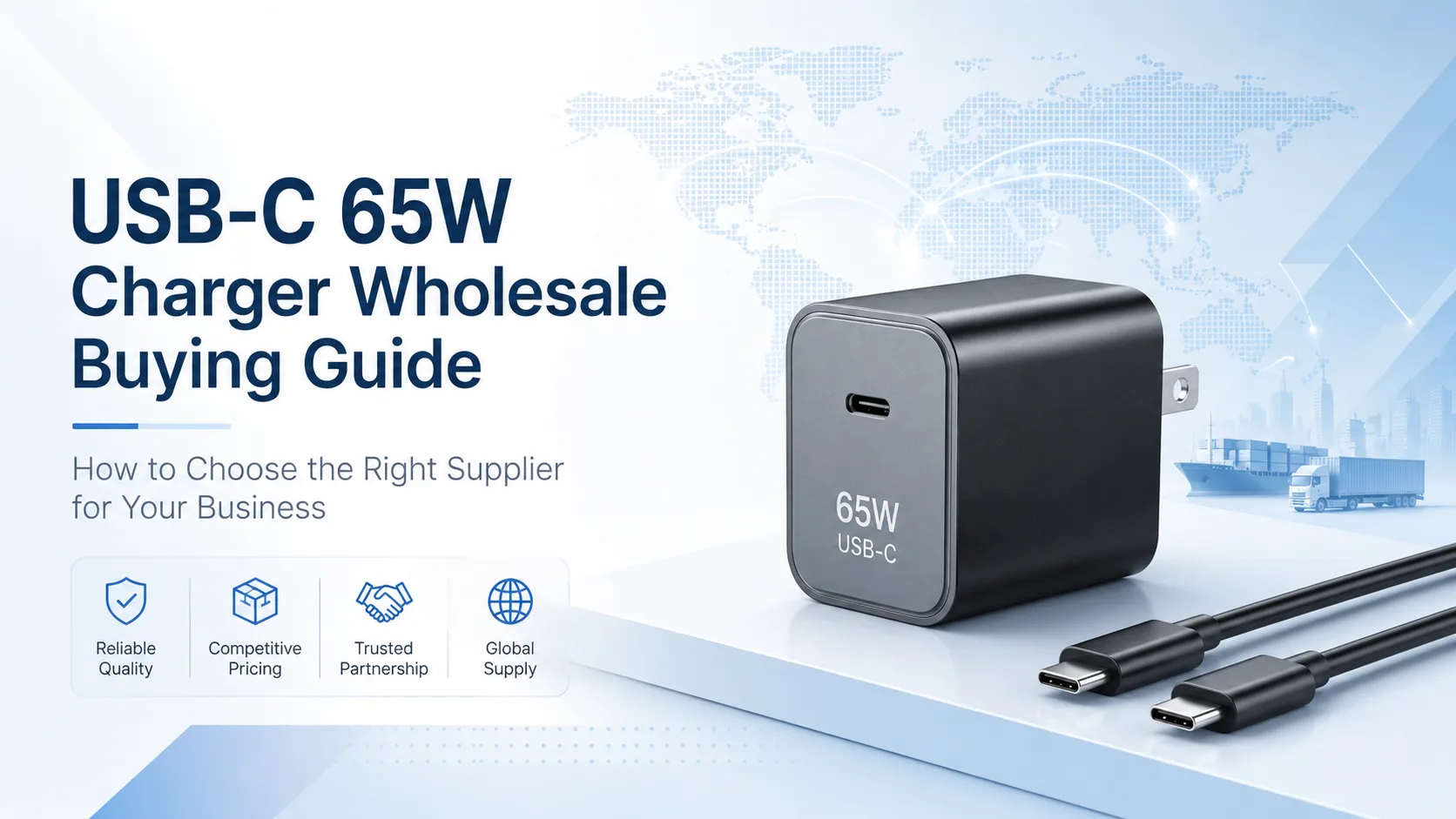
USB-C 65W Charger Wholesale Buying Guide for B2B Buyers
A B2B guide for sourcing USB-C 65W laptop chargers.
Jun 19, 2026
Product Knowledge
A B2B guide for sourcing USB-C 65W laptop chargers.
Jun 19, 2026
Quick Answer: What Should B2B Buyers Look for in a USB-C 65W Charger?
When buying USB-C 65W chargers wholesale, B2B buyers should focus on output stability, USB Power Delivery compatibility, safety certifications, plug options, housing quality, packaging, warranty terms, and the supplier’s production capacity. A reliable 65W USB-C charger should support common PD output profiles, work with laptops, tablets, and smartphones, and meet the compliance requirements of your target market.
For importers, distributors, online sellers, and brand owners, the best choice is not always the cheapest charger. The right product should balance performance, safety, certification, customization, and long-term supply stability.
Why USB-C 65W Chargers Are Popular in Wholesale Markets
USB-C 65W chargers have become one of the most in-demand power adapter categories for B2B buyers. They are compact, versatile, and suitable for a wide range of devices, including laptops, tablets, smartphones, handheld game consoles, and other USB-C powered electronics.
For wholesalers and distributors, 65W is a practical power level. It is powerful enough for many business laptops and premium tablets, while still remaining compact and affordable compared with higher-wattage chargers. This makes the USB-C 65W charger a strong product for electronics retailers, office supply companies, corporate procurement, repair shops, and e-commerce sellers.
A good 65W USB-C charger can serve multiple customer groups:
Laptop users who need a compact replacement charger
Mobile professionals who want one charger for several devices
Retailers selling accessories for USB-C laptops and phones
Corporate buyers purchasing chargers for offices, schools, or teams
OEM brands looking for private-label power adapter solutions
Key Specifications to Check Before Buying in Bulk
Before placing a wholesale order, buyers should carefully review the charger’s technical specifications. Small differences in design and components can affect charging speed, compatibility, safety, and customer satisfaction.
1. Output Power and PD Profiles
A true 65W USB-C charger should support USB-C Power Delivery and provide stable power output across common voltage levels. Typical output profiles may include:
5V / 3A
9V / 3A
12V / 3A
15V / 3A
20V / 3.25A
The 20V / 3.25A output is especially important for many USB-C laptops. Without this profile, the charger may not properly power certain notebook models.
For better device compatibility, buyers can also ask whether the charger supports PPS, short for Programmable Power Supply. PPS can help optimize charging for some smartphones and tablets that support dynamic voltage adjustment.
2. Single-Port or Multi-Port Design
USB-C 65W chargers are available in single-port and multi-port versions.
A single-port 65W charger is simple, stable, and suitable for laptop charging. It is often preferred for replacement charger programs, office procurement, and laptop accessory sales.
A multi-port 65W charger may include USB-C + USB-C or USB-C + USB-A ports. This design is attractive for retail and travel users because it can charge multiple devices at the same time. However, buyers should check how the power is distributed when multiple ports are used. For example, a charger may offer 65W on one USB-C port when used alone, but split the power when two or three devices are connected.
3. GaN or Traditional Silicon Design
Many modern 65W USB-C chargers use GaN technology. GaN chargers are usually smaller, lighter, and more efficient than traditional silicon-based chargers. This makes them attractive for premium retail markets.
However, GaN is not always required. For price-sensitive wholesale projects, a well-designed traditional 65W USB-C charger may still be suitable. The best choice depends on your target market, price point, packaging strategy, and customer expectations.
For premium positioning, choose a compact GaN 65W charger.
For replacement charger distribution, choose a stable and cost-effective standard 65W PD charger.
For private-label retail, compare both options and test samples before confirming the final model.
Safety and Certification Requirements
Safety is one of the most important factors when buying USB-C chargers wholesale. Chargers connect directly to AC power, so poor design or low-quality components can create overheating, unstable output, product returns, or compliance risks.
Depending on your market, you may need certifications such as:
CE for European markets
FCC for the United States
UKCA for the United Kingdom
ETL or UL-related certification for North America
RoHS for restricted substances
DOE Level VI or other energy efficiency requirements
IEC/EN/UL 62368-1 related safety compliance
Before ordering, ask the supplier for valid certificates, test reports, product labels, and model numbers that match the exact charger you are buying. Do not rely only on general claims such as “CE approved” or “high quality.” The certificate should match the product model, factory name, input/output ratings, and target market.
For B2B buyers, compliance is not just about customs clearance. It also affects platform sales, retail acceptance, insurance, and customer trust.
How to Evaluate Charger Quality
A professional supplier should be able to provide clear product details, sample testing, and quality control documents. When comparing USB-C 65W charger suppliers, look beyond the unit price.
Housing and Build Quality
Check the plastic material, surface finish, plug strength, connector alignment, and overall structure. A high-quality charger should feel solid and should not have loose parts, sharp edges, or poor assembly.
Temperature Control
65W chargers can generate heat during operation. A reliable charger should maintain safe temperature performance under normal working conditions. Ask the supplier about thermal design, aging tests, and full-load testing.
Output Stability
Voltage stability is critical for laptops and tablets. Poor output control can cause slow charging, charging interruptions, or device compatibility problems. Before bulk purchasing, test the charger with several devices commonly used by your target customers.
Protection Functions
A quality USB-C 65W charger should include common protection features such as:
Over-voltage protection
Over-current protection
Short-circuit protection
Over-temperature protection
Overload protection
These features help protect both the charger and connected devices.
OEM and Private Label Options
For many B2B buyers, USB-C 65W chargers are not just generic accessories. They are part of a brand, retail program, or product bundle. If you plan to sell under your own brand, ask the supplier about OEM and private-label services.
Common customization options include:
Logo printing on charger housing
Custom color or surface finish
Retail box design
Barcode and SKU labeling
User manual customization
Plug type selection
Cable bundle options
Amazon or e-commerce packaging requirements
Private-label buyers should confirm the minimum order quantity, logo setup cost, packaging lead time, and artwork requirements before placing an order.
Plug Types for Different Markets
USB-C 65W chargers are sold globally, so plug type is an important purchasing factor. Common plug options include:
US plug
EU plug
UK plug
AU plug
Interchangeable plug design
If you sell in multiple countries, an interchangeable plug model may reduce inventory complexity. However, fixed-plug models can be more compact and may offer better cost control for single-market distribution.
Always match the plug type, certification, label, and packaging language to the destination market.
Sample Testing Checklist Before Bulk Order
Before confirming a wholesale order, request samples and test them carefully. A simple sample test can help avoid major problems later.
Use this checklist:
Check the charger label and output ratings
Test charging with USB-C laptops, tablets, and phones
Confirm 65W output with suitable testing equipment
Test charging stability for at least several hours
Check temperature under load
Inspect housing, plug, and USB-C port quality
Review packaging and label accuracy
Confirm certificates and test reports
Test with different USB-C cables
Compare actual sample quality with supplier photos
If possible, test samples from several suppliers before choosing one. The lowest price may not offer the best long-term value.
Common Mistakes When Buying USB-C 65W Chargers Wholesale
Choosing Only by Price
A very low price may mean cheaper components, weaker protection, poor housing, or incomplete certification. For chargers, quality problems can lead to returns, negative reviews, and safety risks.
Ignoring Certification Details
Some suppliers show certificates that do not match the exact model being sold. Always check the model number, factory name, plug type, and output rating.
Not Testing with Target Devices
A charger may work well with one phone but fail to charge certain laptops properly. Test with the devices your customers are most likely to use.
Forgetting Packaging Requirements
Retail packaging, barcode labels, warning labels, and user manuals may be required for your sales channel. Confirm these details before mass production.
Not Confirming Warranty Terms
Ask the supplier about warranty period, defective rate policy, replacement process, and after-sales support. Clear warranty terms are especially important for distributors and long-term wholesale buyers.
How to Choose a Reliable USB-C 65W Charger Supplier
A reliable supplier should offer more than a product list. Look for a partner that understands B2B purchasing, compliance, production control, and export requirements.
When evaluating suppliers, ask these questions:
How many years have you produced power adapters or chargers?
Do you support OEM or private-label orders?
What certifications are available for this exact model?
Can you provide test reports and product specifications?
What is the MOQ for standard and customized orders?
What is the lead time for samples and mass production?
What quality control tests are performed before shipment?
What is your warranty policy?
Can you support US, EU, UK, and AU plug versions?
Can you provide packaging for retail or e-commerce channels?
A professional supplier should answer these questions clearly and provide supporting documents.
Wholesale Price Factors
The price of a USB-C 65W charger depends on several factors:
GaN or non-GaN design
Single-port or multi-port structure
Certification requirements
Plug type
Housing material
Internal component quality
Packaging type
Order quantity
Logo and customization needs
Cable bundle requirements
For B2B buyers, it is better to compare total value instead of unit price only. A slightly higher-quality charger may reduce returns, improve reviews, and create better long-term profit.
Recommended Buyer Strategy
If you are buying USB-C 65W chargers wholesale for the first time, start with a structured sourcing process:
First, define your target market and required certifications.
Second, choose whether you need single-port, multi-port, GaN, or standard models.
Third, request samples from two or three suppliers.
Fourth, test compatibility, temperature, build quality, and packaging.
Fifth, confirm documents, warranty, MOQ, and lead time.
Finally, place a trial order before scaling to larger volume.
This approach helps reduce sourcing risk and gives your business a stronger foundation for long-term sales.
A USB-C 65W charger can support many USB-C laptops, tablets, smartphones, and other compatible devices. Actual charging speed depends on the device, cable, and supported charging protocol.
Yes, many USB-C laptops can be charged with a 65W PD charger, especially business laptops, ultrabooks, and compact notebooks. Buyers should confirm the required voltage and wattage of the target laptop models before purchasing.
Choose a GaN 65W charger if you want a smaller, lighter, and more premium product. For price-sensitive wholesale projects, a standard 65W PD charger may also be suitable if the quality and certifications are reliable.
Yes, many manufacturers offer OEM and private-label services, including logo printing, custom packaging, user manuals, barcode labels, and plug options.
Certification requirements depend on your target market. Common requirements may include CE, FCC, UKCA, RoHS, ETL, UL-related safety compliance, and energy efficiency standards. Always confirm the exact requirements for your country or sales channel.
MOQ depends on the supplier and customization level. Standard models usually have lower MOQ, while custom logo, packaging, or color options may require higher order quantities.
USB-C 65W chargers are a strong wholesale product for electronics distributors, importers, retailers, and private-label brands. They offer wide device compatibility, strong market demand, and flexible product positioning. To choose the right USB-C 65W charger supplier, focus on PD compatibility, stable output, safety certification, product testing, packaging quality, and after-sales support. A reliable charger may cost slightly more, but it can help reduce returns, protect your brand reputation, and support long-term B2B growth. If your business needs USB-C 65W chargers in bulk, work with a supplier that can provide certified products, OEM customization, stable production capacity, and professional export support.